In this article 6 min read
Start by finding out how much a bank will lend you
Before you visit any house, go to a bank or a lender. They look at your income and your debts, then tell you how much they could lend. Some call this pre-qualification. Others call it pre-approval. For you it is the same thing: you learn your ceiling.
Know what it is not. It is not an approved loan, and it does not guarantee the money will be released. Later the bank checks the house and the seller's papers. If something does not add up, the loan stops.
So why bother? It gives you three things. You know which prices to look at. The seller takes you more seriously. And you do not fall for a house you cannot pay for.
For the full process, read our guide to mortgage loans in Nicaragua.
What you can do this week
Take these steps in this order:
- Ask two or three banks or lenders for their document list in writing.
- Gather your valid ID and proof of income. If you work for yourself, gather papers from your business.
- Get your account statements for the last few months.
- Write down your current debts and your credit references.
- Ask what they accept as proof of income if you are not on a payroll, and whether they count income earned abroad.
- Ask for the pre-qualification letter before you visit houses.
Each institution has its own list and adjusts it to your profile. That is why it pays to ask first instead of collecting papers blindly. This matters most if you live abroad and earn there.
Costs the loan does not cover
The bank lends you money for the house. Other costs sit outside the loan, so learn who pays what before you make an offer.
The transfer tax on a sale comes from Law 822 (Tax Concertation Law). Under article 87, item 4 of Law 822, it is the seller's. Look at how it is calculated. Under article 83, item 2 of Law 822, the DGI, the national tax office, charges on the higher of the deed price and its own valuation.
What the Public Registry charges to record your ownership is set by Law 920 (Public Registry Fees Law). The Registry is the government office where property titles are kept. The yearly property tax, called the IBI, comes from Decree 3-95 (Property Tax, IBI) and is paid to the city hall. Without the municipal solvency certificate, which shows the property taxes are up to date, the deed is not registered.
If you look at social-interest housing, Law 677 (social-interest housing) provides a subsidy on the loan rate, with a price cap. Ask the bank whether your house qualifies. If you want to buy near the sea, for example in San Juan del Sur or Tola, read Law 690 (Coastal Zones Development Law). It applies equally to nationals and foreigners.
The cost breakdown is in our guide to costs of buying a house in Nicaragua. For your own case, ask a lawyer or notary in Nicaragua. In Nicaragua the notary is the lawyer who prepares and signs the deed. Ask that person to review the deed with you. Our article on reading the deed before you buy covers the main points.
Compare banks and strengthen your offer
Compare in writing
Ask two or three institutions for a proposal and set them side by side. Look at:
- The interest rate, and whether it is fixed or variable.
- The loan term and the monthly payment it produces.
- Fees and insurance.
- Any charge for paying the loan off early.
- The currency of the loan. Most property is priced in US dollars, so check this one closely.
Strengthen your offer
Make your offer with the pre-qualification letter in hand. Keep your documents ready so the process does not drag. Expect the bank to send someone to value the property, and that value can differ from the asking price. If it comes in lower, you will need to renegotiate or put in more of your own money.
Ask the seller for their papers from the start. The sooner the notary reviews them, the fewer surprises you meet along the way.
The numbers, area by area
For readers who want the detail, here is what sellers ask in each area.
| Area | Median price · houses | Median price · apartments | Listed (sale and rent) · houses |
|---|---|---|---|
| Nicaragua | US$ 230,000 | US$ 259,000 | 2,547 |
| Managua (city) | US$ 265,000 | US$ 207,500 | 1,297 |
| Las Colinas | US$ 332,500 | US$ 407,500 | 119 |
| Santo Domingo | US$ 437,000 | US$ 300,000 | 319 |
| Villa Fontana | US$ 389,500 | US$ 260,000 | 59 |
| Los Robles | US$ 355,000 | no data | 29 |
| Bolonia | US$ 210,000 | no data | 40 |
| Carretera Masaya | US$ 155,000 | US$ 98,800 | 163 |
| Carretera Sur | US$ 299,000 | US$ 165,000 | 139 |
| Las Cumbres | US$ 361,250 | no data | 28 |
A loan is measured against the price of the house, so see where you stand. Across the country, half the houses for sale ask less than US$ 230,000. In Managua city, half ask less than US$ 265,000. In Santo Domingo that rises to US$ 437,000, and in Carretera Masaya it drops to US$ 155,000.
To compare, browse the houses for sale in Managua. These are asking prices, not closing prices, and they can be negotiated. Our article on the price ladder by area has more comparisons.
If your budget is tight, apartments are another option. In Managua city, half the apartments for sale ask less than US$ 207,500.
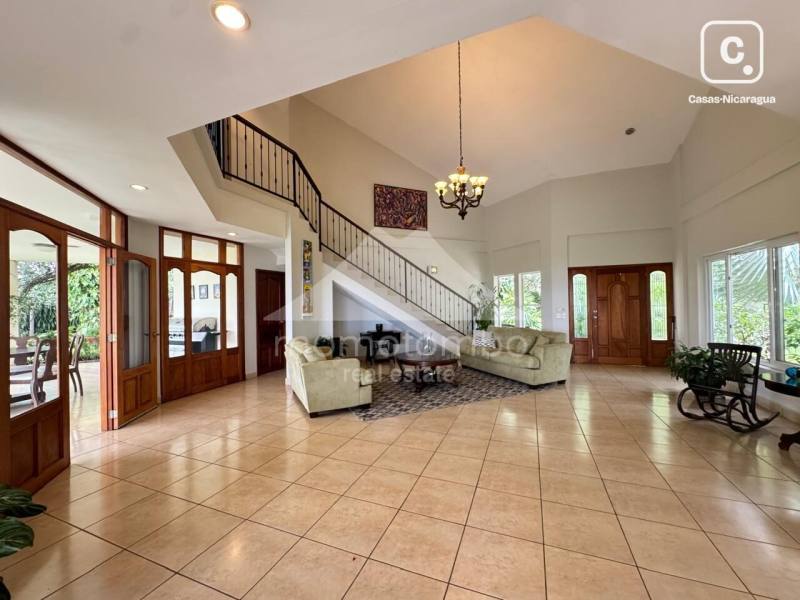
For a concrete reference, there is a house for sale in Santo Domingo at US$ 120,000. Use it as an example when you ask a bank for a simulation. CasasEnNicaragua has 7,364 properties listed for sale and rent, so there is plenty to compare.
Use it as an example when you ask a bank for a simulation.
Frequently asked questions
What does pre-qualification for a home loan mean in Nicaragua?
The bank reviews your income and debts and tells you how much it could lend. It is not an approved loan and does not guarantee the money. The bank still checks the house and the seller's papers.
Can I use income from abroad to qualify for a mortgage in Nicaragua?
It depends on the institution. Ask each bank in writing whether it counts income earned abroad and what proof it accepts.
Who pays the transfer tax when buying a house in Nicaragua?
By law the transfer tax is the seller's, under article 87, item 4 of Law 822. The DGI charges it on the higher of the deed price and its own valuation. Ask a lawyer or notary in Nicaragua about your case.
Where these numbers come from. From live listings on Casas en Nicaragua, measured on Nov 13, 2026, 4:35 p.m. It is the asking price, not the closing price, and we use the median. Full methodology.